TOOLDEX is a large-scale dataset of human tool-use demonstrations captured in a shared multi-camera rig. We densely cover the combinatorial space of tool, action, and object: the same action (e.g., scoop, stir, crush) is performed with many different physical tools, so every trajectory measures how humans flexibly repurpose objects to accomplish a goal. Each trial captures 8 synchronized RGB-D cameras, and a large fraction of the dataset ships with hand-optimized 6DoF object poses, per-frame masks, and hand trajectories — enabling policy learning, affordance discovery, and tool-use generalization studies.
Collection spans one shared scene (cutting-board / tabletop) with 8 calibrated RGB-D cameras. Each trial is one human demonstration of a (tool, action, object) triple with natural variation in grasp, approach, and in-plane pose. Key takeaway: for almost every action we record, multiple tools are demonstrated, yielding rich tool-choice diversity per goal.
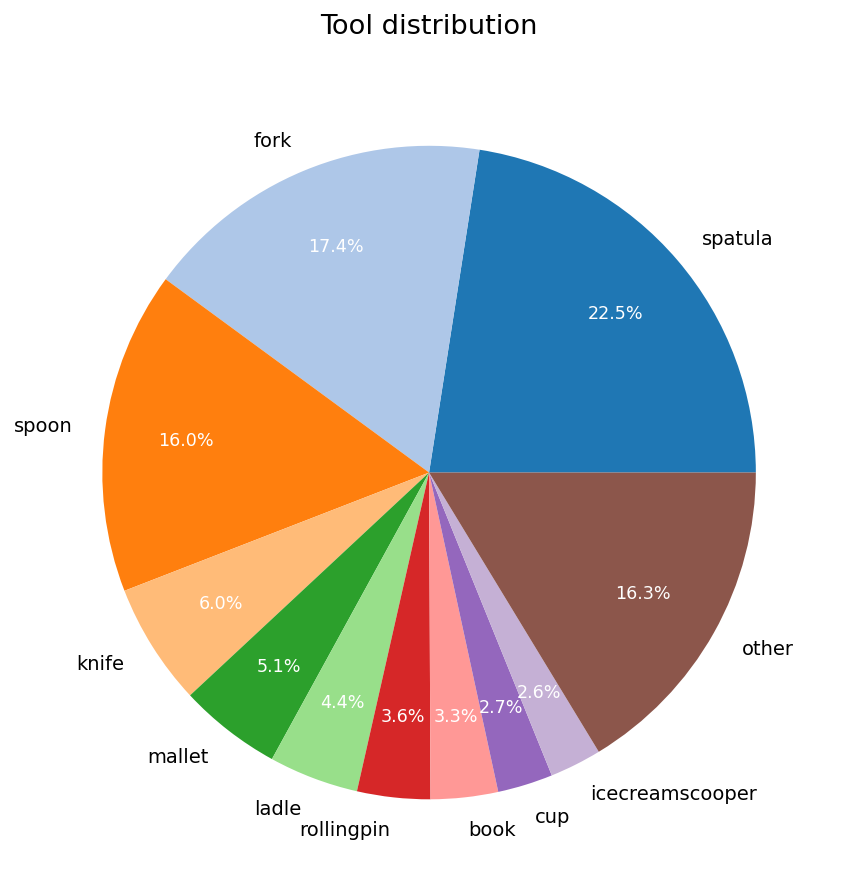
Tool distribution. Share of trials using each physical
tool. Spatulas, forks, and spoons dominate the long tail.
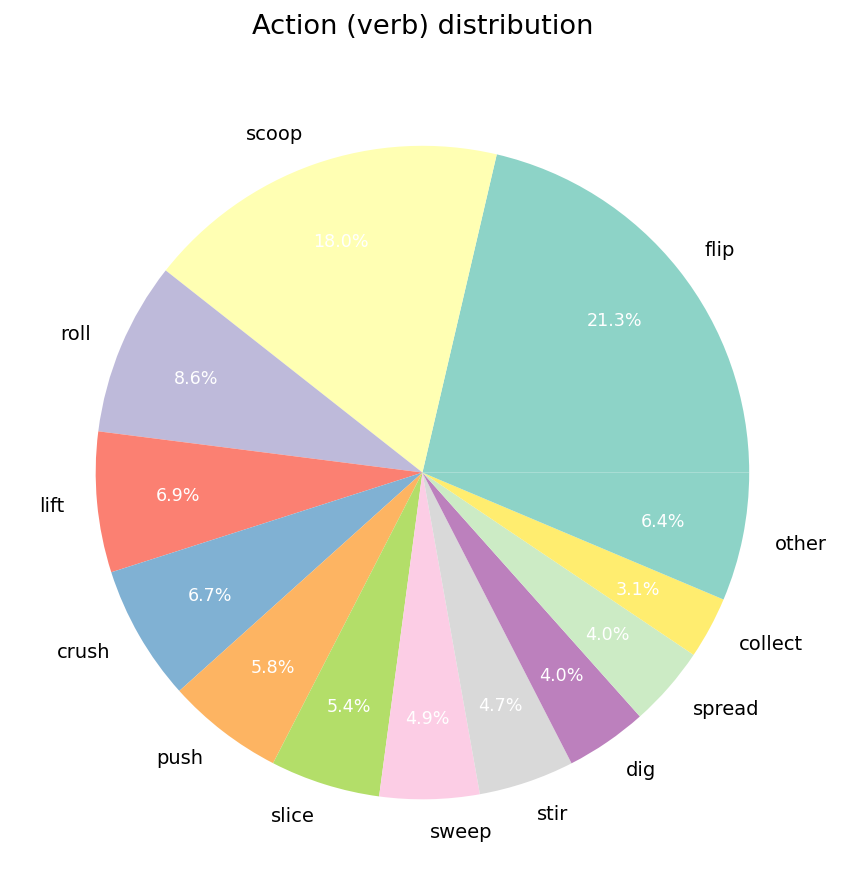
Action distribution. Share of trials per action.
flip, scoop, roll, lift, and crush lead the
set.
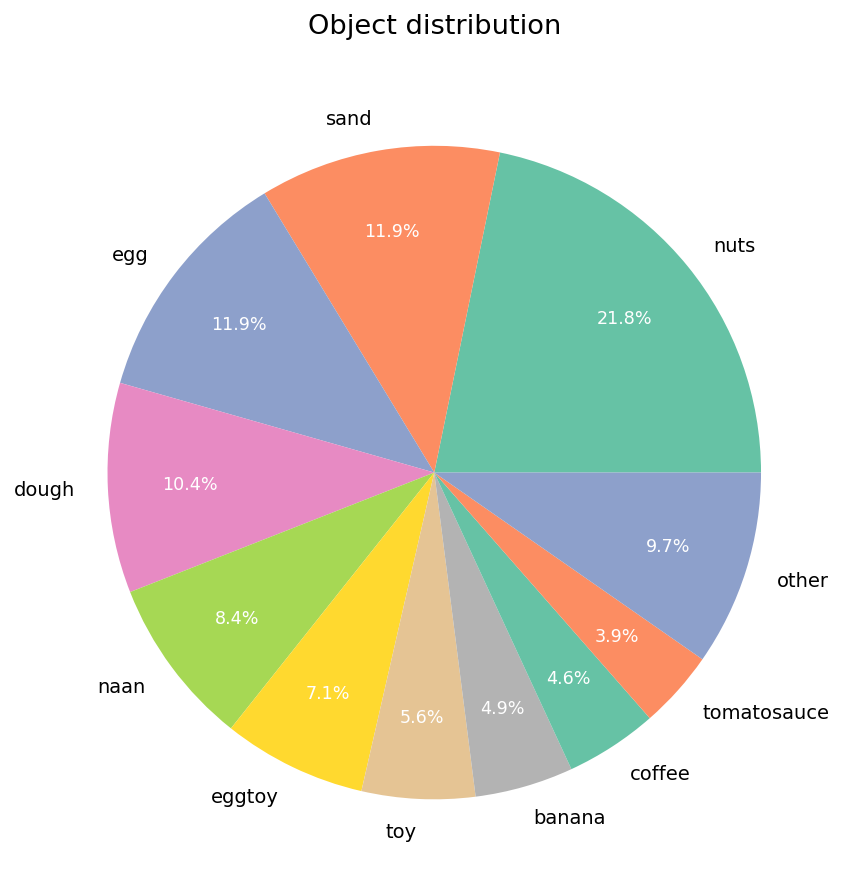
Object distribution. Share of trials per manipulated
object / material — includes egg, dough, sand, nuts, naan, tomato sauce, and
sponge.
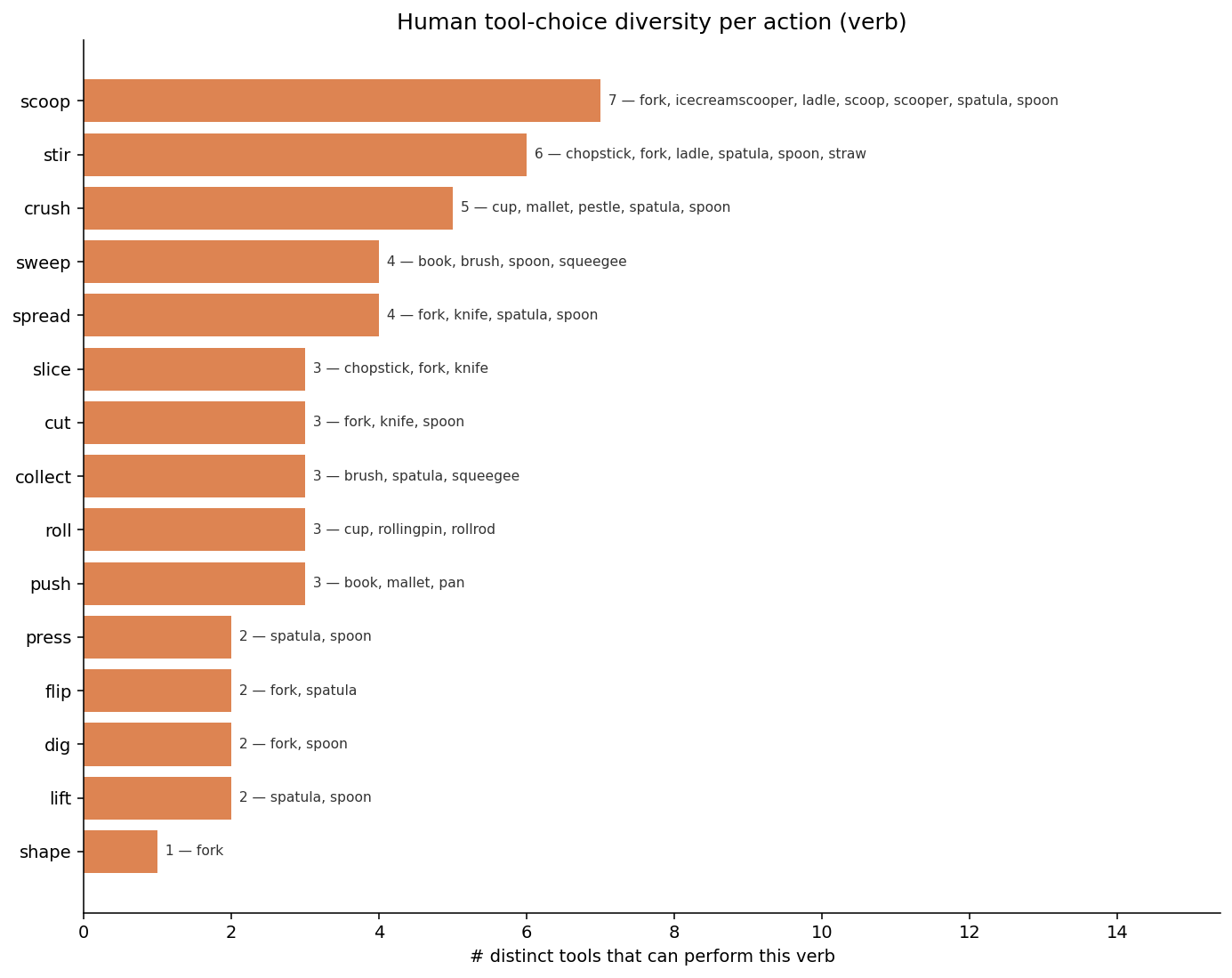
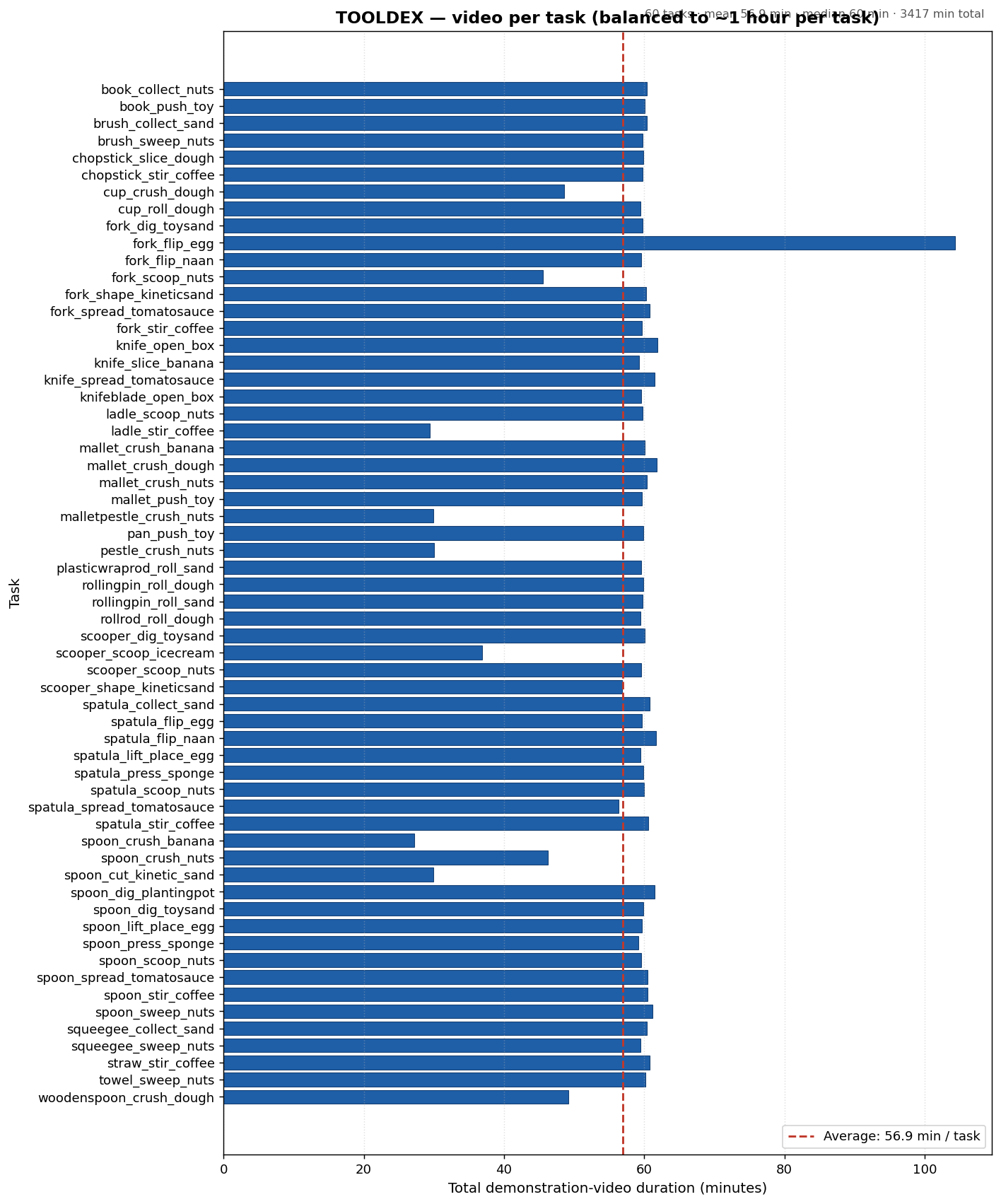
The signature of this dataset is the diversity of how humans perform the same action. scoop is demonstrated with 7 distinct tools, stir with 6, crush with 5, etc. To prevent class imbalance from confounding the analysis, every task is collected to roughly the same total demonstration length (~1 hour), so trial-count differences do not dominate downstream statistics. This shows up in the tool×action heatmap, the per-action tool-choice bar chart, and the per-task duration bar plot below.
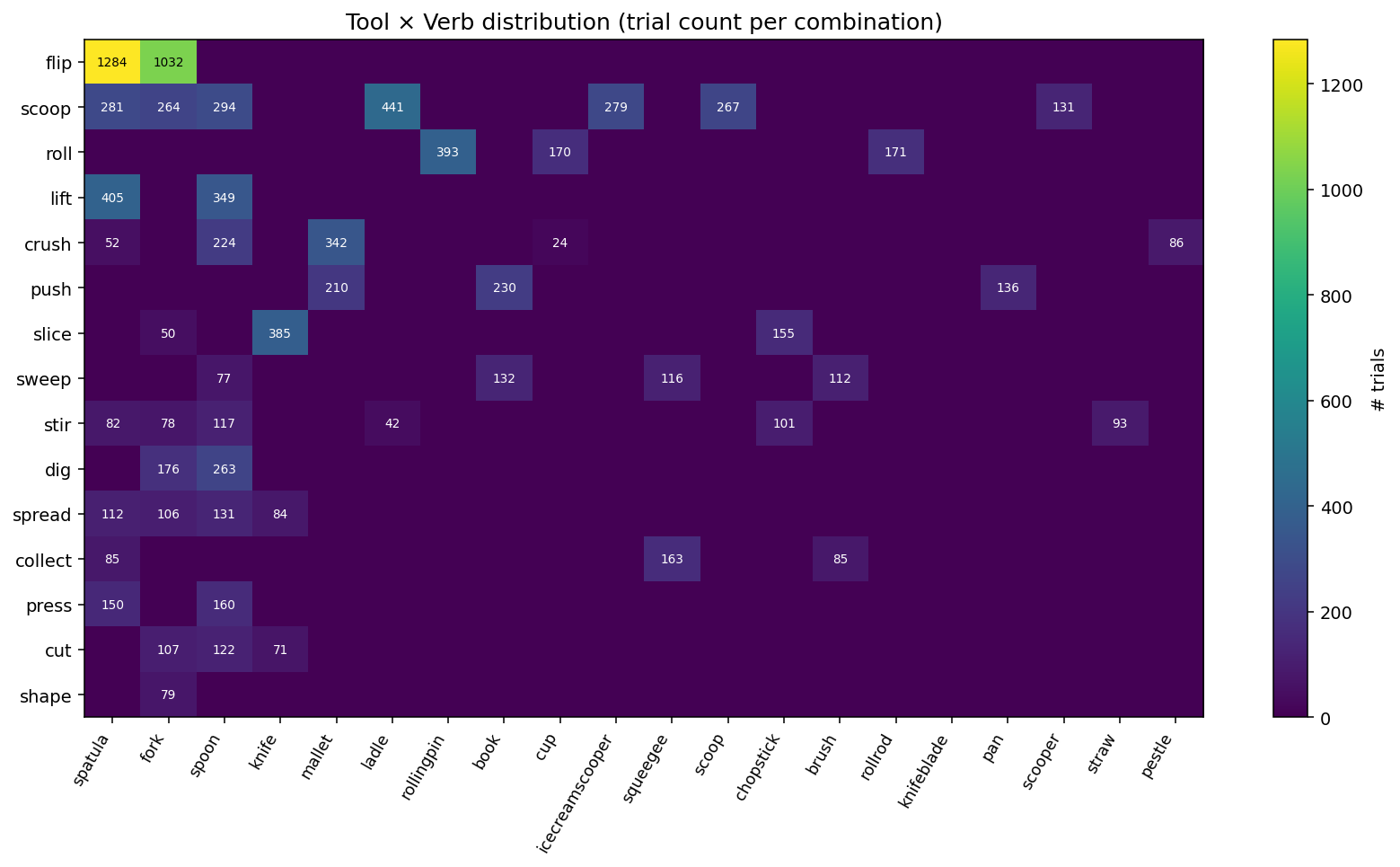
Tool × action heatmap. Each cell is the trial count for a
specific (tool, action) pair. Empty cells indicate affordance gaps; dense rows/columns
indicate highly reused tools/actions.
Tool-choice diversity per action. For each verb, we list
every distinct tool used to realize it in the dataset.
Balanced collection: ~1 hour of demonstration video per
task. Total cam-0 video duration aggregated across all trials of each task_dir. The
dashed red line marks the average per-task duration (57 min across the 60
tasks). Bars cluster around it because we deliberately equalized collection effort
across tasks rather than letting trial counts alone determine total time.
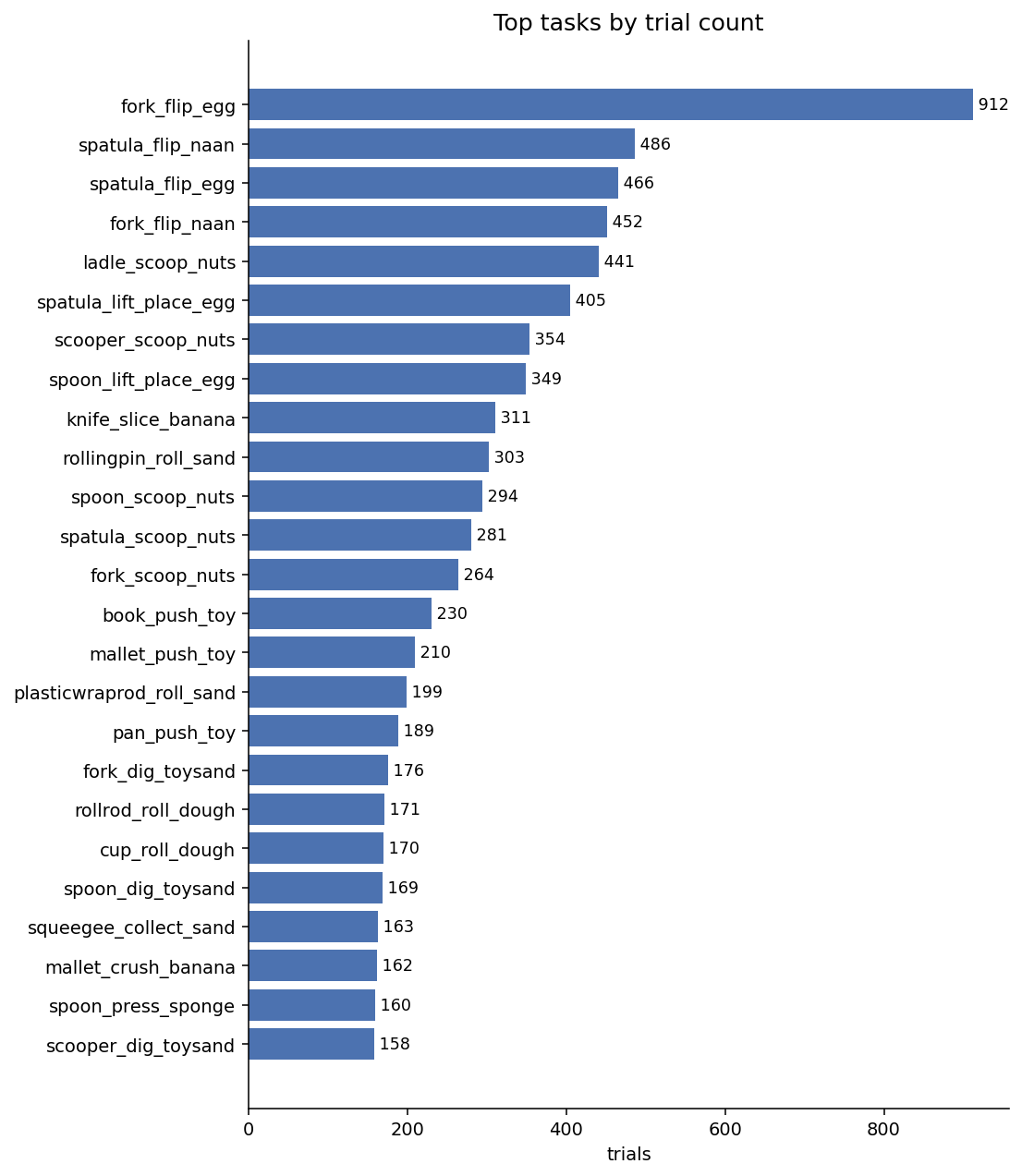
Top task folders by number of trials. The full table and CSV enumerate every task signature and its (tool, action, object) breakdown.
Click a column header to sort; filter by tool / action / object in the visualizer.
| # | task_dir | tools | actions | objects | trials |
|---|---|---|---|---|---|
| loading… | |||||
Our automatic annotation pipeline produces three coordinated outputs for every recorded trial: per-frame 6 DoF tool pose recovered via multi-view FoundationPose fusion, bimanual MANO hand meshes estimated with WiLoR and refined through joint hand–tool optimization, and dense segmentation masks for the target object — including deformable materials such as dough, sauce, and granular media. All annotations are jointly optimized to ensure physical consistency. The video below visualizes these overlaid annotations on a single demonstration, illustrating how hand pose, tool pose, and deformable object state are tracked in concert throughout the interaction.
Joint hand — tool — deformable-object visualization
From 8 sparse calibrated cameras capturing a single timestep, we reconstruct a per-scene 3D Gaussian field and synthesize novel views around the captured rig. Our top variant achieves MUSIQ 71.85 — the highest no-reference quality on this scene among all 3DGS pipelines we tested.
What is unique vs 2025/2026 research: sparse-view 3DGS papers (DropGaussian, FSGS, CoR-GS, DNGaussian, AnySplat) all aim for a stronger training-time regularizer to combat under-constrained Gaussians. Our finding is complementary — the dominant remaining quality gap is texture, not geometry, and a single forward pass through a generative view-degradation prior (Difix3D, NVIDIA 2024) closes it. We pair an under-fit SparseGS backbone with an under-used post-processing prior, and the composition is greater than its parts.
Ground truth (8 cameras)
Ours
MUSIQ
63.26 ↑ · NIQE 5.07 ↓ · BRISQUE 30.66 ↓
PIQE 53.36 ↓
· MANIQA 0.308 ↑ · TOPIQ 0.450 ↑
Five renders of the same novel-view sweep stacked into one canvas. Ours takes the central 50% of the canvas by default; drag any of the four internal seams to wipe between adjacent methods. Left to right: InstantSplat · Ours · Sparfels · SplatFormer · SparseGS.
SparseGS + Difix3D
MUSIQ
71.85 ↑ · NIQE 4.71 ↓ · BRISQUE 21.53 ↓
PIQE 48.76 ↓
· MANIQA 0.361 ↑ · TOPIQ 0.552 ↑
InstantSplat + GSFix3D
MUSIQ
62.25 ↑ · NIQE 4.98 ↓ · BRISQUE 39.07 ↓
PIQE 50.56 ↓
· MANIQA 0.336 ↑ · TOPIQ 0.523 ↑
InstantSplat 7k
MUSIQ
55.90 ↑ · NIQE 5.18 ↓ · BRISQUE 48.90 ↓
PIQE 50.44 ↓
· MANIQA 0.240 ↑ · TOPIQ 0.402 ↑
InstantSplat 1k
MUSIQ
52.83 ↑ · NIQE 5.12 ↓ · BRISQUE 40.68 ↓
PIQE 48.98 ↓
· MANIQA 0.226 ↑ · TOPIQ 0.374 ↑
Sparfels
MUSIQ
55.64 ↑ · NIQE 5.41 ↓ · BRISQUE 44.88 ↓
PIQE 56.03 ↓
· MANIQA 0.263 ↑ · TOPIQ 0.412 ↑
VGGT-X
MUSIQ
55.48 ↑ · NIQE 5.52 ↓ · BRISQUE 48.58 ↓
PIQE 51.74 ↓
· MANIQA 0.262 ↑ · TOPIQ 0.409 ↑
SplatFormer
MUSIQ
47.45 ↑ · NIQE 4.66 ↓ · BRISQUE 34.53 ↓
PIQE 42.59 ↓
· MANIQA 0.198 ↑ · TOPIQ 0.335 ↑
SparseGS
MUSIQ
51.03 ↑ · NIQE 4.81 ↓ · BRISQUE 31.05 ↓
PIQE 49.61 ↓
· MANIQA 0.193 ↑ · TOPIQ 0.370 ↑
Same 8-camera pestle_crush_nuts_ep5 scene, single timestep,
no post-processing on baselines. Direction: MUSIQ↑, NIQE↓, BRISQUE↓, PIQE↓,
MANIQA↑, TOPIQ↑.
| method | MUSIQ↑ | NIQE↓ | BRISQUE↓ | PIQE↓ | MANIQA↑ | TOPIQ↑ |
|---|---|---|---|---|---|---|
| Ours | 63.26 | 5.07 | 30.66 | 53.36 | 0.308 | 0.450 |
| Sparfels | 55.64 | 5.41 | 44.88 | 56.03 | 0.263 | 0.412 |
| VGGT-X | 55.48 | 5.52 | 48.58 | 51.74 | 0.262 | 0.409 |
| InstantSplat | 52.83 | 5.12 | 40.68 | 48.98 | 0.226 | 0.374 |
| SplatFormer | 47.45 | 4.66 | 34.53 | 42.59 | 0.198 | 0.335 |
| SparseGS | 28.86 | 6.77 | 47.24 | 63.12 | 0.116 | 0.187 |
All scores measured on the same 8-camera pestle_crush_nuts_ep5 scene at the
held-out frame-0 timestep.
From 8 sparse calibrated cameras capturing a dynamic scene (10 s · 30 fps), we reconstruct a time-aware Gaussian field and synthesize a novel-view trajectory of equal length. Our top variant reaches MUSIQ 72.03 — the first 4DGS pipeline on this scene to exceed the strongest 3DGS-only result (71.85).
What is unique vs 2025/2026 research: recent 4DGS work (4DGaussians/HexPlane CVPR 2024, Spacetime Gaussians CVPR 2024, MEGA ICCV 2025, Faster-GS CVPR 2026) focuses on architectural changes — learned deformation fields, per-Gaussian polynomial trajectories, entropy-constrained compression, accelerated optimization. None target a key empirical observation: per-frame InstantSplat produces images whose artifact distribution exactly matches what generative view-fixers were trained to remove. We show that a per-frame backbone + an ordered diffusion stack (Difix3D→GSFix3D) at 1080p is +1.46 MUSIQ better than the reverse order, and the full pipeline beats every 4DGS baseline by 8–15 MUSIQ on the same scene.
Ground truth (8 cameras, time-sliced, 10 s @ 30 fps)
Ours
MUSIQ
72.03 ↑ · NIQE 4.50 ↓ · BRISQUE 21.88 ↓
PIQE 38.33 ↓
· MANIQA 0.412 ↑ · TOPIQ 0.561 ↑
Same novel-view trajectory; left half: ours, right half: InstantSplat baseline. MUSIQ 72.03 vs 55.44.
InstantSplat + GSFix3D + Difix3D
MUSIQ
70.57 ↑ · NIQE 4.63 ↓ · BRISQUE 12.92 ↓
PIQE 27.02 ↓
· MANIQA 0.393 ↑ · TOPIQ 0.531 ↑
InstantSplat + Difix3D
MUSIQ
63.48 ↑ · NIQE 5.44 ↓ · BRISQUE 19.45 ↓
PIQE 31.20 ↓
· MANIQA 0.326 ↑ · TOPIQ 0.455 ↑
InstantSplat + GSFix3D
MUSIQ
62.92 ↑ · NIQE 4.31 ↓ · BRISQUE 28.81 ↓
PIQE 38.10 ↓
· MANIQA 0.316 ↑ · TOPIQ 0.506 ↑
InstantSplat only
MUSIQ
55.44 ↑ · NIQE 5.21 ↓ · BRISQUE 39.05 ↓
PIQE 49.62 ↓
· MANIQA 0.232 ↑ · TOPIQ 0.392 ↑
Same 8-camera redrubberspatula_lift_egg_59 scene
(300 frames @ 30 fps, novel-view path [0,4,7,5,6,2,3,1]).
Baselines run without any of our diffusion / 1080p / stack add-ons.
Direction: MUSIQ↑, NIQE↓, BRISQUE↓, PIQE↓, MANIQA↑, TOPIQ↑.
| method | MUSIQ↑ | NIQE↓ | BRISQUE↓ | PIQE↓ | MANIQA↑ | TOPIQ↑ |
|---|---|---|---|---|---|---|
| Ours | 72.03 | 4.50 | 21.88 | 38.33 | 0.412 | 0.561 |
| InstantSplat | 55.44 | 5.21 | 39.05 | 49.62 | 0.232 | 0.392 |
Same 8-camera scene; the green row is our full pipeline — the first 4DGS result on this scene to exceed 71.85 (the 3D-only ceiling).
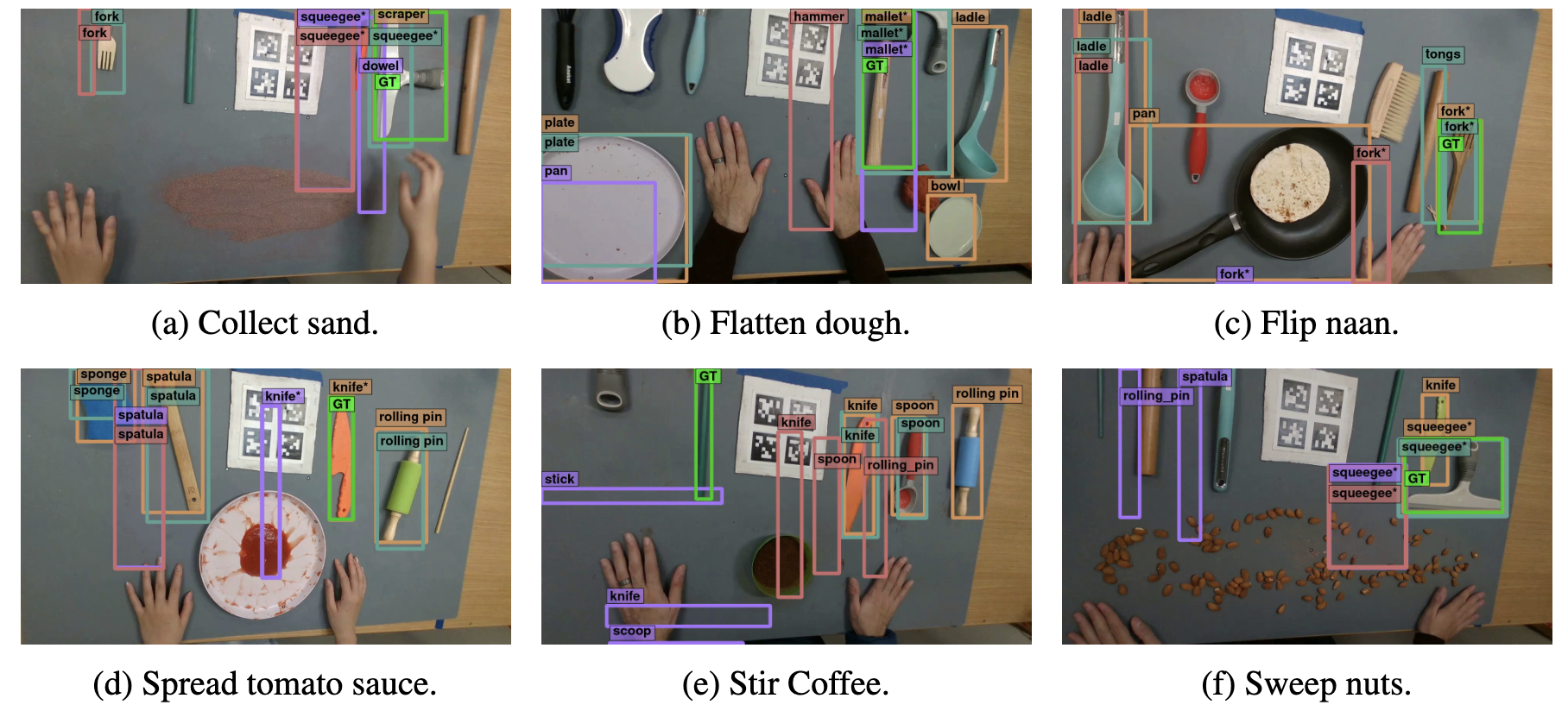
We benchmark VLMs at three levels of physical tool-use reasoning. For each example, the model receives the first frame from a top-view RGB camera and a natural-language instruction such as “stir the coffee.” The evaluation set contains 160 manually verified demonstrations spanning 32 task variants.
Tool selection tests whether a model understands which visible objects can physically perform the requested action. The model returns the names of all plausible tools: for example, a spoon, ladle, or scoop could each be proposed for “scoop the nuts.” Because several objects may be functionally valid, multiple answers are allowed.
Spatial grounding tests whether the model can connect its tool choice to the correct object instance in the image. For every selected tool, the model predicts a rectangular bounding box. We compute intersection over union (IoU) only when the predicted tool category matches the demonstrated tool, separating localization errors from semantic selection errors.
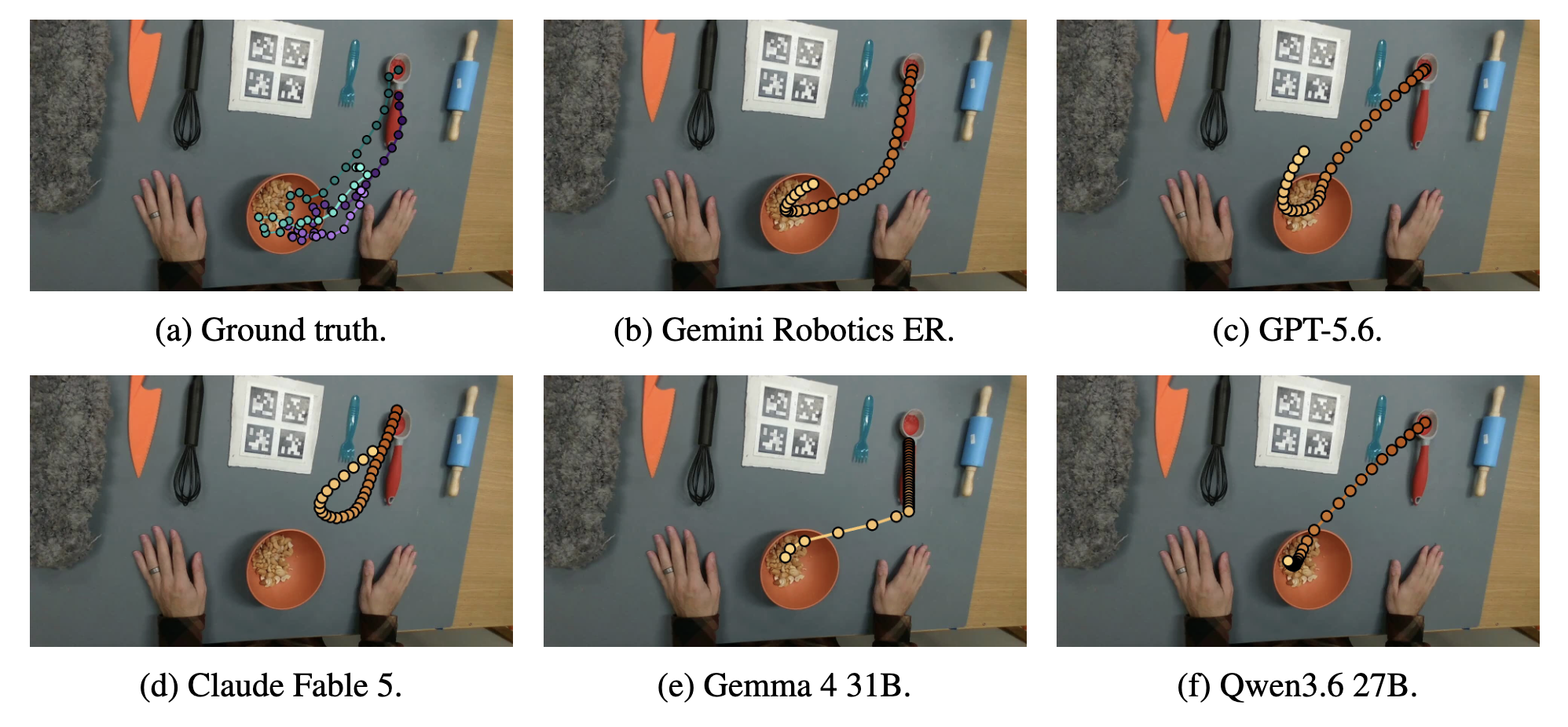
Behavioral planning asks how the tool should move after it has been identified. To isolate motion planning from selection, the model is explicitly given the demonstrated tool name along with the image and instruction. It outputs an ordered sequence of 2D image coordinates describing a high-level path from the tool to and through the interaction region—for example, approaching a cup and tracing a stirring motion. “Successfully evaluated” is the percentage of responses that can be parsed and scored as valid trajectories.
Predictions are compared with two ground-truth paths. The tool-center trajectory projects the center of the tool through time. The correspondence-aware trajectory instead tracks a point on the functional part of the tool, such as a spoon tip, so it better represents the intended interaction region. Mean L2 measures average pointwise pixel error and is sensitive to the progression of the motion; Chamfer-L2 compares the overall sets of path points and emphasizes path shape. Lower values indicate closer agreement with the human demonstration.
Tool accuracy measures demonstrated-tool matches; BBox IoU measures localization for semantically matched predictions. Best results are shown in bold.
| Model | Tool Acc. | BBox IoU |
|---|---|---|
| GPT-5-mini | 0.662 | 0.300 |
| GPT-5.5 | 0.738 | 0.890 |
| Claude-Sonnet-4.6 | 0.800 | 0.641 |
| Claude-Opus-4.7 | 0.800 | 0.564 |
| Gemini-3-Flash | 0.756 | 0.050 |
| Gemini-3.1-Pro | 0.781 | 0.010 |
| Qwen-3.5-9B | 0.557 | 0.003 |
| Qwen-3.6-27B | 0.638 | 0.004 |
Results across 160 selected trajectories. Distance metrics are reported in pixels; higher is better for successful evaluation and lower is better for path errors.
| Model | Successfully evaluated |
Tool-center Mean L2 |
Tool-center Chamfer-L2 |
Corr.-aware Mean L2 |
Corr.-aware Chamfer-L2 |
|---|---|---|---|---|---|
| GPT-5.6 Sol. | 90.0% | 241.05 | 113.45 | 237.55 | 98.05 |
| Gemma 4 31B | 86.9% | 259.96 | 104.17 | 269.73 | 107.31 |
| Gemini Robotics ER | 77.5% | 230.37 | 91.91 | 223.15 | 74.44 |
| Claude Fable 5 | 71.3% | 263.33 | 146.37 | 234.89 | 102.61 |
| Qwen 3.6 27B | 37.5% | 244.88 | 128.44 | 228.61 | 103.71 |
Experiment Setup. To evaluate whether TOOLDEX provides robot-transferable demonstrations for dexterous policy learning, we test two mimic-style reinforcement learning settings that both use TOOLDEX trajectories as reference signals. ManipTrans adapts ManipTrans and trains a residual policy for an Inspire hand in IsaacGym. Arm+Hand RL is an independently implemented mimic RL pipeline that jointly controls a Sharpa hand and a Franka FR3 arm in IsaacLab. The policies are trained with an identical pipeline across all tasks without task-specific tuning. Unlike ego-only datasets where hand–tool trajectories must be estimated from a single noisy viewpoint, TOOLDEX's multi-view-fused annotations can be consumed directly without additional refinement. We select demonstrations from 6 tasks spanning 4 action categories (stir, scoop, crush, collect) with 254–600 frames (≈4–10 s at 60 Hz). After training, we evaluate each policy for 200 episodes with randomized start frames.
Success rate (%): the object reaches within 5 cm of the demonstration's final pose under randomized start frames. ManipTrans and Arm+Hand RL report mean ± std over 3 seeds; Kinematic retarget (open-loop replay of the reference) and BC (behavior cloning of the reference) are single-run reference baselines. Best per task in bold.
| Task | Kinematic retarget | BC | ManipTrans | Arm+Hand RL |
|---|---|---|---|---|
| Stir coffee (spatula) | 7.0 | 1.6 | 52.2 ± 2.2 | 72.7 ± 0.8 |
| Scoop nuts (ladle) | 22.2 | 9.1 | 62.9 ± 0.4 | 66.8 ± 1.3 |
| Crush banana (mallet) | 10.2 | 2.6 | 53.0 ± 1.9 | 55.8 ± 0.2 |
| Scoop nuts (scooper) | 31.0 | 9.8 | 45.3 ± 2.0 | 31.3 ± 0.6 |
| Crush nuts (pestle) | 7.0 | 1.9 | 16.8 ± 0.2 | 46.7 ± 2.4 |
| Collect sand (squeegee) | 6.9 | 2.6 | 12.6 ± 0.7 | 57.5 ± 1.9 |
| Average | 14.0 | 4.6 | 40.5 | 55.1 |
The Arm+Hand RL policy sweeping with a squeegee: executed in simulation (left) and deployed on the real Sharpa hand mounted on a Franka FR3 arm (right).
Simulation
Real robot
Real robot
For each task with hand-optimized annotations, we render a representative trial as a skeleton-overlay video — MANO hand joints (21 per hand), bones, and a fading 60-frame wrist tail trace the human trajectory through the action. A featured worked example is shown below at full size; the remaining tasks follow as small tiles. Click any video to play.
fork_flip_egg / 20260205_bigwoodenspatula_flip_eggtoy_in_blackpan_1.
Left/right MANO hand joints projected into camera 0; fingers colored per group
(thumb = red, index = green, middle = blue, ring = yellow, pinky = magenta);
wrist dot with a 60-frame fading tail traces the trajectory. Detection-failure sentinels
and failed pose-fits are masked out; remaining per-sample jitter is smoothed by a
Hampel filter (window 7, 3σ) before drawing.
Browse a stratified random subset of trials. Filter by tool, action, or object to see how humans solve the same task in different ways.
Open the visualizer@misc{tooldex2026,
title = {TOOLDEX: An Ego-Exo Human Demonstration Dataset for Creative Physical Tool Use},
year = {2026},
}